How To Rank in Google AI Overviews for the Long Run
Table of contents
To rank in Google AI Overviews, a page needs to already rank in the top results for the query, answer the question directly in a self-contained passage of roughly 130 to 170 words, use question-form headings, carry clear authorship and dates, cite sources, and be crawlable by Google-Extended. Overviews draw mostly from top-10 pages, so this guide covers the ranking work and the citability work together.
Google AI Overviews (formerly Search Generative Experience) represent a fundamental shift in how search results are delivered. These AI-generated summaries appear at the top of search results, synthesizing information from multiple sources to provide comprehensive answers. Ranking within these overviews isn't just about short-term tactics—it requires a sustainable, strategic approach to content creation and optimization.
Understanding Google AI Overviews: The New Search Landscape
AI Overviews fundamentally change the visibility equation. Traditional ranking factors still matter, but Google's AI now curates and synthesizes information differently. The algorithm evaluates sources based on authority, comprehensiveness, and relevance to generate these summaries.
What Makes AI Overviews Different:
- Content is synthesized from multiple sources, not just the top result
- Citations provide attribution, creating new visibility opportunities
- User intent matching becomes even more critical
- Information density and clarity drive selection
The strategic imperative: Position your content as a credible, comprehensive source that AI systems can confidently reference.
Core Principles for Long-Term AI Overview Visibility
1. Authoritative Content Architecture
Google's AI prioritizes sources it can trust. Building long-term authority requires systematic development of expertise signals across your domain.
Strategic Implementation:
- Develop comprehensive topic clusters that demonstrate depth across related subjects
- Establish clear author credentials and expertise markers
- Build authoritative backlink profiles from recognized industry sources
- Maintain consistent publishing standards that signal reliability
Authority isn't built overnight. Focus on creating a body of work that demonstrates consistent expertise over time, allowing AI systems to recognize your domain as a reliable information source.
2. Comprehensive Information Coverage
AI Overviews synthesize information from sources that provide complete, nuanced answers. Surface-level content rarely makes the cut.
Content Development Framework:
- Address questions from multiple angles and perspectives
- Include supporting data, statistics, and evidence
- Cover related subtopics that provide context
- Anticipate follow-up questions and address them proactively
Think beyond individual keywords. Google's AI understands semantic relationships and rewards content that thoroughly explores topics rather than simply targeting specific phrases.
3. Structured Data and Semantic Clarity
Machine-readable signals help AI systems understand and categorize your content effectively. Proper implementation creates competitive advantages that compound over time.
Technical Optimization Priorities:
- Implement schema markup for articles, FAQs, how-tos, and relevant content types
- Use clear hierarchical heading structures (H1, H2, H3) that signal content organization
- Create descriptive, keyword-rich meta descriptions that summarize content accurately
- Develop internal linking structures that establish topical relationships
Structured data serves as a communication layer between your content and AI systems. Invest in proper implementation for sustained visibility benefits.
4. E-E-A-T Signal Optimization
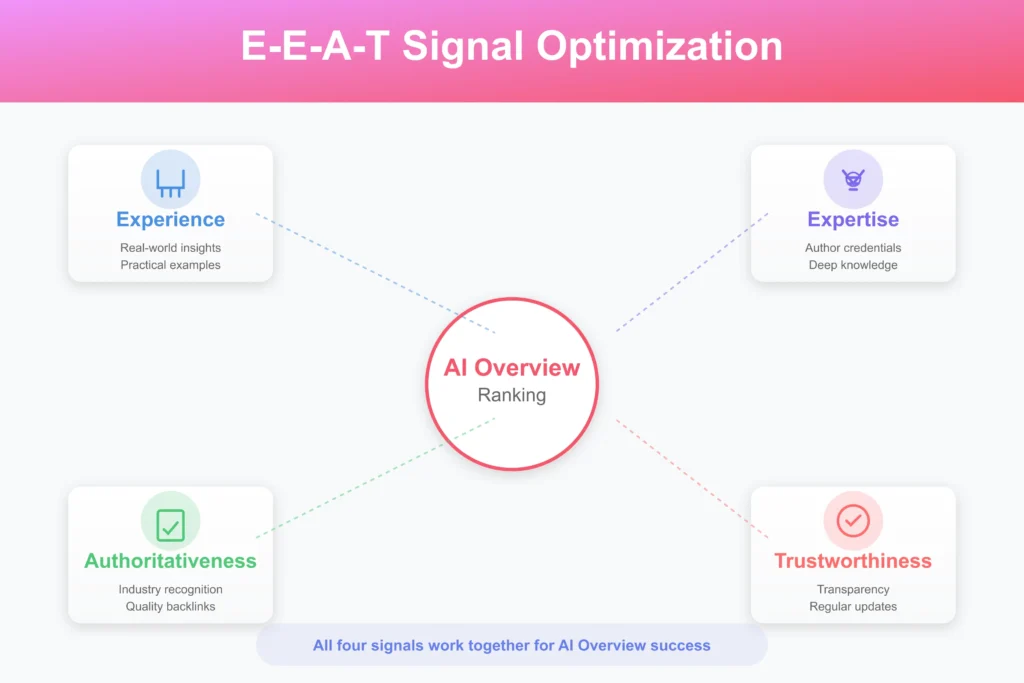
Experience, Expertise, Authoritativeness, and Trustworthiness remain foundational to Google's evaluation framework, especially for AI-curated content.
Building E-E-A-T for AI Visibility:
- Showcase real-world experience and practical insights in your content
- Develop and display author credentials prominently
- Earn mentions and links from authoritative industry publications
- Maintain transparency about information sources and methodology
- Update content regularly to reflect current information and expertise
AI systems evaluate trustworthiness signals at scale. Consistent demonstration of expertise across your content portfolio builds the credibility necessary for long-term inclusion in AI Overviews.
Advanced Strategies for Sustained AI Overview Rankings
Query Intent Mapping
AI Overviews appear most frequently for informational and question-based queries. Strategic content development requires understanding which queries trigger these features and why.
Intent Analysis Approach:
- Identify queries in your niche that consistently generate AI Overviews
- Analyze the content characteristics of sources being cited
- Map your content strategy to high-opportunity query patterns
- Develop content formats that align with how information is synthesized
Create content that naturally answers the questions AI systems are trained to address. This alignment increases citation probability across multiple related queries.
Multi-Format Content Strategy
AI systems pull information from various content formats. Diversification increases citation opportunities across different query types.
Format Diversity:
- Long-form comprehensive guides for complex topics
- Concise, direct answers for specific questions
- Step-by-step tutorials with clear procedural information
- Data-driven articles with statistics and research findings
- Comparison content that evaluates multiple options
Different formats serve different query intents. A balanced content portfolio positions you for inclusion across varied search scenarios.
Content Freshness and Maintenance
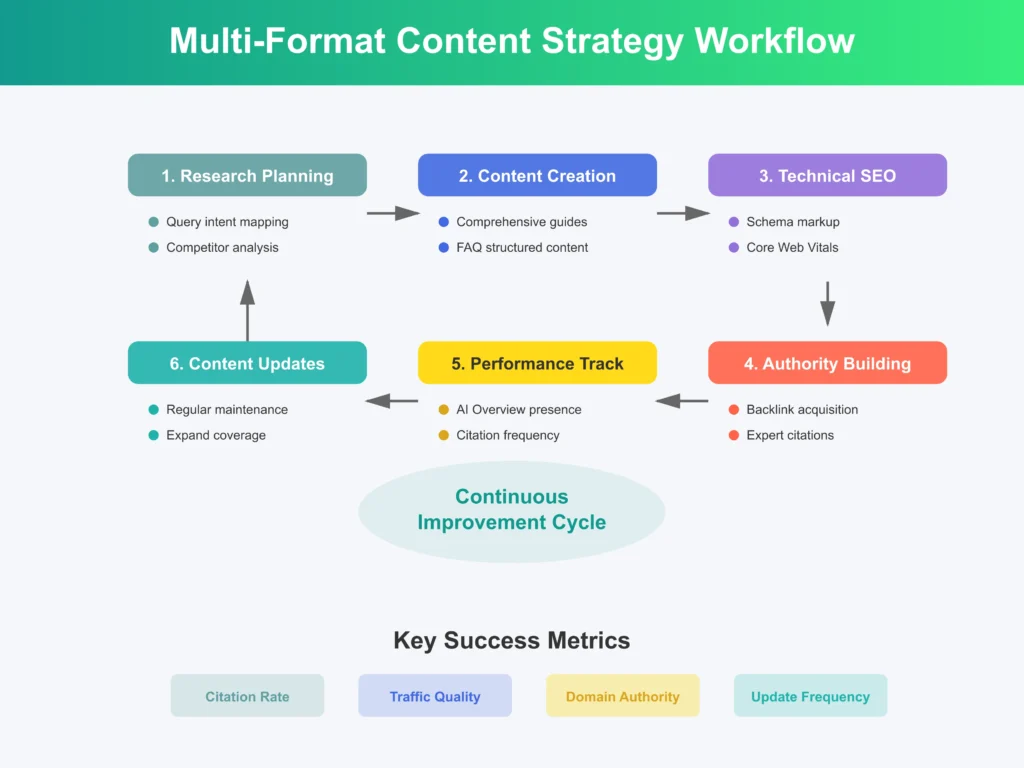
AI systems favor current, well-maintained content. Long-term visibility requires systematic content refresh strategies.
Maintenance Framework:
- Establish quarterly content audits for high-priority pages
- Update statistics, examples, and references to maintain relevance
- Expand existing content to address emerging related topics
- Add new sections that reflect evolving industry developments
- Monitor competitor content to identify coverage gaps
Freshness signals compound over time. Regular updates demonstrate ongoing expertise and reliability, strengthening your position as a go-to source.
Natural Language Optimization
AI systems understand conversational queries and natural language patterns. Content that mirrors how people actually ask questions performs better in AI Overview scenarios.
Language Strategy:
- Write in clear, conversational prose that addresses questions directly
- Include variations of key concepts using natural synonyms
- Structure content around question-answer frameworks
- Use transitional phrases that create logical information flow
- Avoid keyword stuffing in favor of natural language expression
The goal: Create content that sounds authoritative yet accessible, matching the tone AI systems prefer when synthesizing answers.
Technical Infrastructure for AI Overview Success
Site Performance and Core Web Vitals
Technical performance influences the AI system's confidence in recommending your content. Speed, stability, and user experience metrics matter more than ever.
Performance Optimization:
- Achieve strong Core Web Vitals scores across mobile and desktop
- Implement efficient caching and content delivery strategies
- Optimize images and media for fast loading without quality loss
- Minimize render-blocking resources that delay content display
- Ensure mobile responsiveness and touch-friendly interfaces
Technical excellence removes barriers to AI citation. Poor performance signals unreliability, regardless of content quality.
XML Sitemaps and Crawl Optimization
Helping AI systems discover and understand your content efficiently creates indexing advantages that benefit long-term visibility.
Crawl Strategy:
- Maintain clean, updated XML sitemaps that reflect content priorities
- Use robots.txt appropriately to guide crawler focus
- Implement canonical tags to consolidate duplicate content signals
- Create logical URL structures that reflect content hierarchy
- Monitor crawl errors and resolve issues promptly
Efficient crawling ensures your best content receives proper evaluation for AI Overview inclusion.
Measurement and Iteration Framework
Tracking AI Overview Presence
Understanding your current AI Overview visibility establishes baselines for improvement and validates strategy effectiveness.
Monitoring Approach:
- Identify target queries where AI Overviews appear in your niche
- Track citation frequency across priority topics
- Monitor which content types receive the most AI citations
- Analyze competitor presence in AI Overviews for similar queries
- Document seasonal or trending patterns in AI Overview appearance
Data-driven insights guide strategic refinement. Regular monitoring reveals what's working and where opportunities exist.
Performance Analysis and Optimization
Long-term success requires continuous learning and adaptation based on performance data.
Analysis Framework:
- Compare cited content characteristics against non-cited content
- Evaluate traffic patterns from AI Overview citations
- Assess user engagement metrics for AI-sourced visitors
- Test content variations to identify optimization opportunities
- Document successful patterns for replication across the content portfolio
Iteration based on evidence compounds advantages over time. Each optimization cycle strengthens your competitive position.
Future-Proofing Your AI Overview Strategy
Emerging Trends and Adaptations
AI-driven search continues evolving. Sustainable strategies anticipate future developments while maintaining current best practices.
Forward-Looking Considerations:
- Multimodal content incorporating images, video, and interactive elements
- Voice search optimization as conversational AI expands
- Entity-based SEO that strengthens your brand as a recognized authority
- Integration with AI assistants beyond traditional search interfaces
- Privacy-first approaches as data regulations evolve
Build flexibility into your content strategy. Adaptability ensures relevance as AI systems become more sophisticated.
Building Competitive Moats
Long-term dominance in AI Overviews requires creating defensible advantages that competitors can't easily replicate.
Sustainable Competitive Advantages:
- Proprietary research and original data that others must cite
- Deep expertise demonstrated through comprehensive content libraries
- Strong brand recognition that signals authority to AI systems
- Community engagement that generates natural mentions and links
- Systematic content quality standards that maintain consistency
These advantages compound over time, creating barriers to entry that protect your AI Overview presence.
Conclusion: The Long Game
Ranking in Google AI Overviews for the long run isn't about gaming algorithms or finding shortcuts. It requires commitment to fundamental content excellence: comprehensive coverage, demonstrated expertise, technical optimization, and continuous improvement.
The Sustainable Path Forward:
- Invest in depth over breadth, building authoritative topic clusters
- Prioritize user value in every content decision
- Maintain technical infrastructure that supports content discovery
- Monitor performance and iterate based on evidence
- Stay adaptable as AI systems evolve
The content that succeeds in AI Overviews today and will continue succeeding tomorrow serves users genuinely and comprehensively. Build that foundation, optimize systematically, and the visibility follows naturally.
Your strategic focus: Create the content that AI systems confidently cite because it represents the best available answer. Everything else is an implementation detail.
What are Google AI Overviews, and how do they differ from regular search results?
Google AI Overviews (formerly known as Search Generative Experience or SGE) are AI-generated summaries that appear at the top of search results, synthesizing information from multiple sources to provide comprehensive answers. Unlike traditional search results that simply list links in order of ranking, AI Overviews use Google's generative AI to extract, analyze, and combine information from various web pages into a single, cohesive response.
The key differences include: AI Overviews appear above traditional organic results, they cite multiple sources within a single answer, they provide more contextual and nuanced information, and they're designed to answer complex queries without requiring users to click through multiple pages. For content creators, this means visibility isn't just about ranking #1 anymore it's about being selected as a credible, citable source that AI systems trust to include in their synthesized responses.
How long does it take to start appearing in Google AI Overviews?
The timeline for appearing in Google AI Overviews varies significantly based on your website's existing authority, content quality, and technical optimization. For established websites with strong domain authority, you might see citations within 1-3 months of publishing comprehensive, well-optimized content. For newer sites or those building authority, expect 6-12 months of consistent effort before regular AI Overview appearances.
However, this isn't just about waiting—it's about active optimization. The fastest path to AI Overview visibility includes: publishing comprehensive content that thoroughly answers user questions, implementing proper schema markup and structured data, building authoritative backlinks from recognized industry sources, maintaining strong E-E-A-T signals throughout your content, and regularly updating your content to ensure freshness and accuracy. Long-tail, specific queries typically offer quicker wins than highly competitive broad keywords. Focus on establishing expertise in niche topics first, then expand to broader terms as your authority grows.
Do I need to change my entire SEO strategy for AI Overviews?
No, you don't need to completely overhaul your SEO strategy, but you should expand and refine it. The fundamental principles of good SEO—creating high-quality content, building authority, optimizing technical elements, and serving user intent—still apply to AI Overviews. However, AI-driven search does place additional emphasis on certain factors.
Focus on these enhancements to your existing strategy: increase content comprehensiveness and depth (AI systems favor thorough answers over surface-level content), strengthen E-E-A-T signals more deliberately by showcasing author credentials and expertise, implement structured data and schema markup consistently across your site, optimize for natural language and conversational queries, create multiple content formats that address different aspects of topics, and establish clear information hierarchy that AI systems can easily parse and understand. Think of it as SEO evolution rather than revolution—you're building upon proven foundations while adapting to how AI systems evaluate and select content for inclusion in overviews.
Can small businesses and new websites compete in AI Overviews against major brands?
Yes, absolutely! AI Overviews actually create unique opportunities for smaller players to gain visibility. Unlike traditional rankings where domain authority heavily favors established brands, AI systems prioritize content quality, relevance, and comprehensiveness when selecting sources to cite. This means a well-researched, expertly-written article from a smaller site can be cited alongside or even instead of content from major publications.
Your competitive advantages as a smaller site include: the ability to create highly specific, niche content that larger sites overlook, deeper expertise in specialized topics where you have unique experience, more agile content updates and responsiveness to emerging trends, authentic first-hand experience that resonates with E-E-A-T requirements, and the opportunity to build authority systematically in focused topic areas. Start by dominating long-tail, specific queries in your niche where competition is lower. Use these wins to build credibility, then gradually expand to broader terms. Many small businesses find that AI Overviews level the playing field by valuing expertise and content quality over pure domain size. Focus on being the definitive resource for your specific area of expertise, and AI systems will recognize and cite that authority regardless of your site's age or size.