
Table of Contents
You have a great business. Your customers love you. But when someone nearby searches for what you offer on Google, your competitor shows up — not you.
That is a local SEO problem, and it is more common than you think. Across India, thousands of small and medium businesses are invisible on Google Maps and local search results, not because their business is bad, but because they have not set up local SEO correctly.
This guide covers everything you need to know about local SEO for Indian businesses in 2026 — from setting up your Google Business Profile to building local citations, managing reviews, and tracking your rankings. Whether you are a shop owner in Delhi, a clinic in Mumbai, or a contractor in Bangalore, this guide is for you.
| Quick definition: Local SEO is the process of optimizing your online presence so that your business shows up when people nearby search for what you sell or offer. It is what gets you on Google Maps, in the local 3-pack, and into voice search results like ‘near me’ queries. |
1. What is local SEO and why it matters for Indian businesses
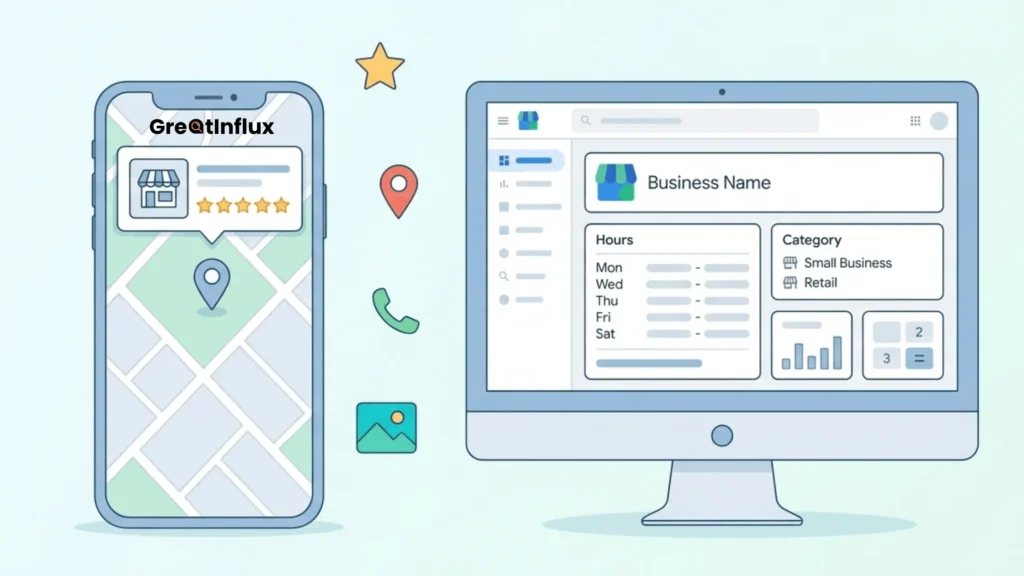
Local SEO (Search Engine Optimisation) is a set of strategies that help your business appear in location-based search results. When someone types ‘dentist in Gurugram’ or ‘best biryani near me’ on Google, the results they see are driven by local SEO.
India is one of the fastest-growing mobile-first markets in the world. Over 700 million Indians are online, and a large percentage of them use Google to discover local businesses before making a purchase decision. According to Google’s own research, searches with the phrase ‘near me’ have grown by more than 130% year-over-year in India, and more than 70% of consumers who search locally visit a business within 24 hours.
For Indian business owners, this represents a massive opportunity — but only if your business is visible in those results.
The Google local 3-pack
When someone searches for a local business or service, Google displays a prominent block of three business listings at the top of the results page. This is called the local 3-pack (or map pack). It shows the business name, star rating, address, phone number, hours, and a link to directions.
Getting into the local 3-pack can dramatically increase calls, website visits, and footfall for your business. Studies consistently show that the 3-pack captures over 40% of all clicks on local search results pages. Local SEO is the work that gets you there.
Local SEO vs regular SEO
Regular SEO focuses on ranking your website pages for broad keyword searches. Local SEO specifically focuses on ranking your business for searches in a defined geographic area — your city, neighbourhood, or district.
The signals that Google looks at for local SEO are different from regular SEO. They include your Google Business Profile, the consistency of your business name and address across the internet, your customer reviews, and how relevant your business is to the searcher’s location.
2. How Google decides which local businesses to rank
Google uses three primary factors to determine local search rankings. Understanding these factors is the foundation of an effective local SEO strategy.
Relevance
Relevance refers to how well your business listing matches what someone is searching for. If someone searches for ‘chartered accountant in Noida’ and your Google Business Profile lists ‘accounting services’ as your primary category, you are relevant to that query. The more accurately and completely you describe your business, the more relevant Google considers you.
Distance
Distance refers to how far your business is from the person doing the search, or from the location term used in the search. If someone searches for ‘plumber near me,’ Google estimates their current location and shows the closest plumbers. You cannot change how far your business is from a searcher, but you can make sure your address and service area are correctly set up so Google knows exactly where you operate.
Prominence
Prominence refers to how well-known and trusted your business is, both online and offline. A business with hundreds of positive Google reviews, strong backlinks, and consistent mentions across the web will rank higher than a business with no online presence, even if it is slightly closer or equally relevant. Prominence is the factor you have the most control over, and it is where most of the work of local SEO happens.
| Pro tip: Google also considers your website’s overall authority and the quality of your on-page content when ranking your business locally. A strong website that mentions your location and services clearly will support your local SEO efforts significantly. |
3. Setting up and optimising your Google Business Profile
Your Google Business Profile (GBP) — formerly called Google My Business — is the single most important asset for local SEO. It is the listing that appears in Google Maps and the local 3-pack. If you have not claimed and verified your GBP, do that before anything else.
Step 1: Claim and verify your listing
Go to business.google.com and search for your business. If a listing already exists, claim it. If not, create a new one. Google will verify your ownership by sending a postcard with a code to your business address, or in some cases through phone verification or video recording.
Verification is essential — an unverified listing has limited visibility in search results.
Step 2: Fill out every section completely
An incomplete GBP profile is a missed opportunity. Google rewards businesses that provide more information because it can serve more relevant results to searchers. Make sure you have filled out:
- Business name (use your exact legal or trading name — no keyword stuffing)
- Business category (primary and secondary categories)
- Address or service area
- Phone number
- Website URL
- Business hours including special holiday hours
- Business description (use your primary keywords naturally)
- Products or services with descriptions and prices
- Photos — interior, exterior, team, products
Step 3: Choose the right business categories
Your primary category is the most important signal you send to Google about what you do. Choose the most specific category that accurately describes your main service. For example, a dental practice should choose ‘Dentist’ not just ‘Health’ or ‘Medical clinic.’
You can add secondary categories to cover additional services. A general physician who also offers paediatric care might add ‘Pediatrician’ as a secondary category.
Step 4: Post regularly on GBP
Google Posts are short updates you can publish directly on your GBP listing. They appear in your listing and can show up in search results. Use posts to announce offers, share news, highlight services, and publish events. Businesses that post regularly signal to Google that they are active, which can improve ranking visibility.
Aim to post at least once or twice a week. Posts expire after 7 days, so consistency matters.
4. Building local citations across Indian directories
A local citation is any online mention of your business name, address, and phone number — often abbreviated as NAP. Citations appear in business directories, review sites, social media platforms, and local websites.
Google cross-references your NAP data across the internet to verify that your business is legitimate and that the information you provide is consistent. The more high-quality, consistent citations you have, the more confident Google becomes about your business — and the better your local rankings.
Top Indian directories to list your business on
Start by getting your business listed on the most authoritative Indian directories and platforms:
- JustDial — one of the most visited local directories in India
- IndiaMART — essential for B2B businesses
- Sulekha — strong in services and home improvement
- Yelp India — growing in urban metros
- GreatInflux — growing local business directory for Indian SMBs
- Yellow Pages India
- Hotfrog India
- Foursquare
- Bing Places for Business
- Apple Maps — growing with iPhone users in India
Beyond these, look for industry-specific directories. Doctors should list on Practo. Lawyers on Vakilsearch or Bar Council directories. Restaurants on Zomato and Swiggy.
NAP consistency — the golden rule of local SEO
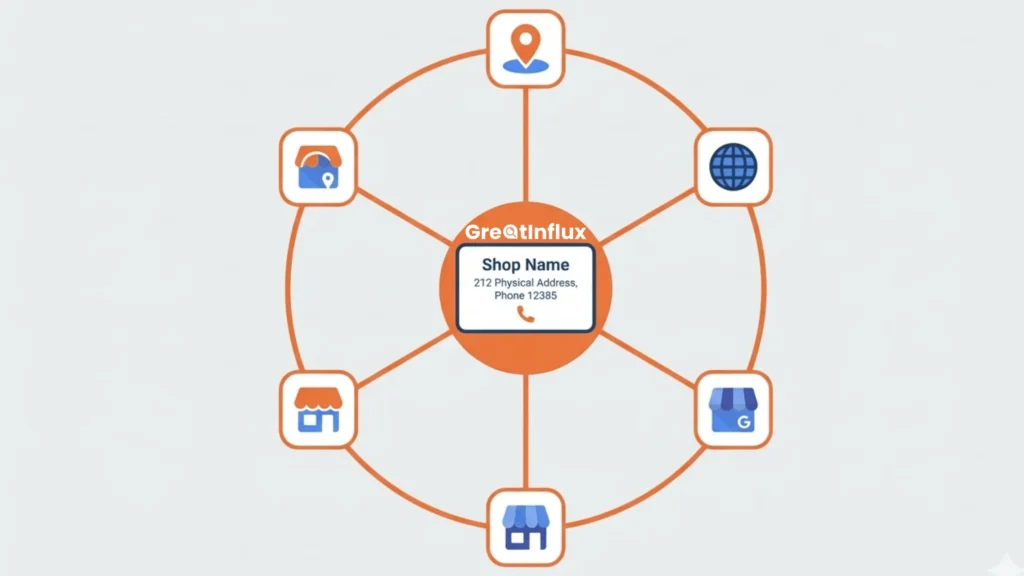
Every listing must use exactly the same name, address, and phone number. Even small differences — like ‘Pvt Ltd’ vs ‘Private Limited,’ or a different phone number format — create confusion for Google and weaken your citation signal.
Before you start building citations, decide on your canonical NAP — the exact format you will use everywhere — and stick to it without exception.
| Example: If your business is ‘Sharma & Sons Electricals’ at ’14, Sector 18, Noida, UP 201301,’ use that exact format on every directory. Do not use ’14/Sector 18′ on one site and ’14, Sector 18′ on another. Consistency builds trust. |
5. Getting and managing customer reviews

Customer reviews are one of the strongest local ranking signals. A business with 200 positive reviews at a 4.5-star average will almost always outrank a competitor with 10 reviews at 4.8 stars. Both quantity and recency of reviews matter.
How to get more reviews ethically
Google’s policies allow you to ask customers for reviews — you just cannot offer incentives or write reviews yourself. The most effective way to collect reviews is to make it easy by sending a direct link to your GBP review page.
The best moments to ask for a review are immediately after a successful transaction, after a positive customer support interaction, or when a repeat customer makes a purchase. A simple WhatsApp message or SMS with a link works extremely well in India.
How to respond to reviews
Respond to every review — positive and negative. Responding to positive reviews shows appreciation and signals activity. Responding to negative reviews shows potential customers that you take feedback seriously and handle issues professionally.
When responding to a negative review, stay calm, acknowledge the concern, offer to resolve it offline, and avoid arguing. Potential customers read both the reviews and the responses.
6. Local keyword research and on-page optimisation
Getting your website to support your local SEO requires using the right keywords throughout your pages — particularly location-specific keywords.
Finding local keywords for your business
Local keywords typically follow a structure of [service] + [location]. For example: ‘web designer in Pune,’ ‘pest control Hyderabad,’ or ‘CA firm Connaught Place Delhi.’
Use Google’s autocomplete to discover what people are actually searching for in your area. Type your service into Google and note the suggestions that appear. These are real searches people are making. Google Keyword Planner, Ubersuggest, and Answer The Public are also excellent free tools for local keyword research.
Where to use local keywords on your website
Once you have your target local keywords, use them in the following places on your website:
- Page title tag — include your primary keyword and city
- Meta description — include the location and a compelling reason to click
- H1 heading — your main page heading should include your primary service and location
- First 100 words of body content — establish relevance early
- URL slug — for example /seo-agency-delhi
- Alt text of images — describe images with location context where relevant
- Footer — include your full address and phone number on every page
7. Schema markup for local businesses
Schema markup is code you add to your website that helps Google understand your business information. For local businesses, the LocalBusiness schema is the most important type to implement.
LocalBusiness schema lets you tell Google your exact business name, address, phone number, opening hours, and the services you offer — in a structured format that search engines can read reliably. Implementing this schema can improve how your business appears in search results and increases your chances of appearing in rich results.
If your website is built on WordPress, plugins like Yoast SEO or Rank Math make it easy to add LocalBusiness schema without writing any code. For custom-built websites, you or your developer can add JSON-LD schema directly to the page.
8. Measuring your local SEO results
You cannot improve what you do not measure. Tracking the right metrics will tell you whether your local SEO efforts are working and where to focus next.
Google Business Profile Insights
Your GBP dashboard provides data on how many people viewed your profile, how they found it (direct search vs discovery search), and what actions they took — phone calls, website clicks, direction requests. Check these metrics every week.
Google Search Console
GSC shows you which search queries are bringing people to your website, how often your pages appear in search results, and your average ranking position. Filter by location to see how your site performs for Indian searches specifically.
Rank tracking tools
Use a rank tracking tool like Semrush, Ahrefs, or the free Google Search Console position data to monitor where you rank for your target local keywords over time. Tracking rankings over 3-6 months will show you whether your local SEO strategy is producing results.
Phone calls and form submissions
The ultimate measure of local SEO success is business results — calls, enquiries, and walk-ins. Use call tracking (available through most CRM and marketing platforms) to attribute phone calls to Google search. Track form submissions in Google Analytics with goal tracking.
| Benchmark: For most Indian businesses starting local SEO from scratch, expect to see measurable improvement in GBP views and calls within 6-8 weeks of optimising your profile and building citations. Ranking in the local 3-pack for competitive keywords typically takes 3-6 months. |
9. Common local SEO mistakes Indian businesses make
Avoiding common mistakes is just as important as implementing best practices. Here are the errors that most often hold Indian businesses back from ranking locally.
- Keyword stuffing in the business name on GBP — Google can suspend your listing for this
- Using different NAP details across different directories
- Ignoring negative reviews instead of responding
- Not adding any photos to the GBP profile
- Setting the wrong primary category on GBP
- Having no local keywords on the website itself
- Not verifying the GBP listing
- Creating duplicate GBP listings for the same location
- Forgetting to update hours during festivals and holidays
- Using a virtual office address without disclosing it to Google
10. Local SEO for service-area businesses in India
Not every business has a physical shopfront. Plumbers, electricians, home tutors, freelancers, and delivery businesses often work from home or travel to customers. These are called service-area businesses (SABs), and they require a slightly different approach to local SEO.
When setting up GBP for a service-area business, you can hide your address and instead define your service area by city, district, or pincode. You should clearly list every area you serve in your GBP service area settings.
For SABs, building local citations and getting reviews from customers across different areas is especially important, as it signals to Google the geographic range of your business activity.
Recommended next steps
Now that you understand the foundations of local SEO for Indian businesses, here is how to go deeper on each key area:
- Read our step-by-step guide on optimising your Google Business Profile for India
- See the best Indian business directories to build your local citations
- Learn how to get more Google reviews for your business ethically
- Discover how to do local keyword research for your city or neighbourhood
If you would prefer to have an expert handle your local SEO, GreatInflux offers affordable local SEO services built specifically for Indian businesses. From GBP optimisation to full citation management and monthly reporting, we handle everything so you can focus on running your business.
How long does local SEO take to work in India?
For most Indian businesses, you can expect to see initial improvements in Google Business Profile views and website visits within 6 to 8 weeks of optimising your GBP and building consistent citations. Getting into the local 3-pack for competitive keywords typically takes 3 to 6 months of consistent effort. Less competitive locations and niches may see results faster.
What does local SEO cost in India?
Local SEO costs in India vary depending on the scope of work and the agency or freelancer you hire. A basic local SEO package from an agency typically starts at Rs. 8,000 to Rs. 20,000 per month and covers GBP optimisation, citation building, and monthly reporting. Full-service local SEO campaigns for competitive industries can range from Rs. 25,000 to Rs. 60,000 per month.
Does local SEO work for small businesses?
Yes, local SEO is one of the most effective marketing channels for small businesses precisely because it levels the playing field. A well-optimised local Lawyers business like can outrank large national chains in local search results if they have a stronger GBP, more reviews, and better local citations. Small businesses with a specific location focus often find local SEO delivers better ROI than any other digital marketing channel.
What is NAP and why does it matter for local SEO?
NAP stands for Name, Address, and Phone number. It refers to the basic contact information for your business. NAP consistency matters for local SEO because Google cross-references your business details across dozens of websites and directories. If your name is spelled differently on JustDial than it is on your website, or your phone number is different on Sulekha than on your GBP, Google sees these inconsistencies as a trust signal problem and may rank your business lower in local results.
Can I do local SEO myself or do I need an agency?
The foundational elements of local SEO — claiming and optimising your Google Business Profile, building directory citations, and collecting reviews — are things most business owners can do themselves. However, technical elements like schema markup, website optimisation, and competitive link building typically benefit from professional expertise. Many businesses start with DIY local SEO and bring in an agency once they are ready to compete more aggressively or expand to new service areas.
How do near-me searches work for local businesses in India?
Near-me searches are queries where the user includes the phrase ‘near me’ or where Google infers local intent from the context — for example, ‘plumber’ typed on a mobile device often triggers local results. Google uses the searcher’s device location to show the most relevant nearby businesses. To appear in near-me searches, your business needs a verified Google Business Profile with a correctly set address or service area, a consistent NAP across citations, and positive reviews.
