AI Adoption in Small Business: Statistics for 2027 From the Census Bureau and Pew
 GreatInflux Team
·11 min read
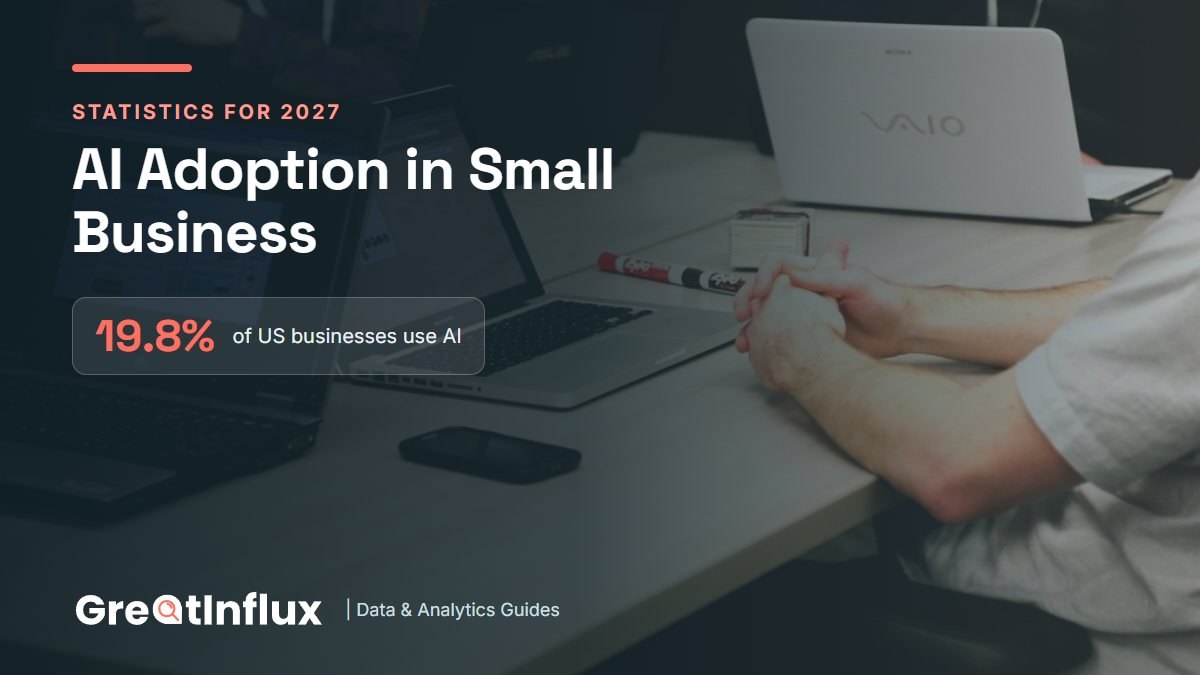
Table of contents
If you put the question of small business AI use to ten software companies, you'll hear ten different figures, and most will be north of 50%. The U.S. Census Bureau reports a far lower number, roughly one in five businesses, with the smallest firms using AI least. Nobody here is lying, because the two sides ask different questions of different people. Still, the gap matters if you own a business and worry you've fallen behind, since the louder numbers make it sound as if everyone else has this figured out.
They haven't. What the official data shows is a real shift that's uneven: larger firms and certain industries lead, and very small businesses move slowest. You can take that as reassurance and as an opportunity. On this page you'll see what Pew Research Center and the Census Bureau actually measured, why other reports disagree with them, and how a small business can start using AI to save time without taking on risk.
AI adoption statistics at a glance
| Statistic | Figure | Source |
|---|---|---|
| U.S. businesses using AI (national rate, 3 May) | 19.8% | U.S. Census Bureau (BTOS) |
| Range of business AI use, Dec 2025 to May | 17% to 20% | U.S. Census Bureau (BTOS) |
| Firms with 250+ employees using AI | 37% | U.S. Census Bureau (BTOS) |
| Firms with 100 to 249 employees using AI | 32% | U.S. Census Bureau (BTOS) |
| Firms with 4 or fewer employees using AI | Less than 20% | U.S. Census Bureau (BTOS) |
| U.S. adults who have used ChatGPT | 34% | Pew Research Center (2025) |
| Employed adults using ChatGPT for work | 28% (up 20 points since 2023) | Pew Research Center (2025) |
| Employed adults aged 18 to 29 using it at work | 38% | Pew Research Center (2025) |
| ChatGPT weekly active users worldwide | 800 million | OpenAI (October 2025) |
How many businesses use AI?
Roughly one in five U.S. businesses use AI. The Census Bureau's Business Trends and Outlook Survey put overall use between 17% and 20% across the stretch between December 2025 and early May, ending at 19.8% nationally. Firms were asked whether they use AI in any business function.
The figures in the Census Bureau's report on AI use by businesses run from 14 December 2025 to 3 May. In that window, "overall AI usage hovered between 17% and 20%", and the nation finished at 19.8%.
Every two weeks the Business Trends and Outlook Survey goes out to a large sample of employer businesses. Few other sources follow the same question over time using one consistent method, so it's what you want if you're trying to tell whether adoption is truly climbing or just getting more airtime.
Why did the numbers change?
The Census Bureau changed the wording of its question. Until then it asked whether firms used AI "in producing goods or services", and in November 2025 it widened the wording to AI use "in any business function", which also covers marketing, admin and customer service. Newer rates run higher, so you shouldn't compare them directly with older ones.
According to the same report, the question was "originally framed around AI use 'in producing goods or services'" and later revised "to ask businesses whether they were using AI 'in any business function.'"
Statistics need context, and this is a good case. When an article says AI adoption "doubled", see whether the wording shifted between surveys. Take a business that uses ChatGPT to write its newsletter: it would have answered "no" under the old wording and "yes" under the new one, even though nothing about the business itself had changed.
Do small businesses use AI less?
Yes, clearly. In the Census survey, 37% of firms with at least 250 employees and 32% of firms with 100 to 249 employees used AI, while fewer than 20% of firms with four or fewer employees did. Larger firms have more repetitive tasks to automate and more staff to test tools.
Among the Census findings, the size gap is one of the most useful, because it explains why owners of small businesses so often feel behind. They read about AI at big companies while running a business where they're also the marketer, the bookkeeper and the receptionist.
Most AI tools a small business would use are free or cheap to try, so money isn't the main obstacle. Time and confidence are, meaning knowing which task to start with and how to judge the output. An afternoon can solve that, and so we treat the gap as an opportunity and not a verdict.
Is the size gap closing?
Not yet. The Census Bureau found that between December 2025 and May, AI use increased among firms with at least 20 employees but didn't change significantly among firms with fewer than 20. In other words, the gap between small and larger firms widened slightly over that period.
The report says so plainly: "AI use increased among firms with at least 20 employees but didn't change significantly among firms with fewer than 20 employees." That's useful context if you own a small business. Rivals of your size probably aren't using AI in an organised way either, and if you compete with larger firms, they're pulling ahead. You'll likely notice it first in how fast they respond, how much content they publish and how quickly they analyse their own data.
Which industries use AI most?
The Information sector and the Finance and Insurance sector lead by a wide margin. In the Census survey, 39.7% of Information businesses and 33.9% of Finance and Insurance businesses used AI, compared with the national figure of 19.8%. Retail sits near the bottom, where around 14% of businesses use AI while about 17% expect to do so within six months.
Here are the sector figures from the Census report:
| Group | Using AI now | Expect to use AI in the next six months |
|---|---|---|
| All U.S. businesses | 17% to 20% (19.8% on 3 May) | 20% to 23% |
| Information sector | 39.7% | About 42% |
| Finance and Insurance | 33.9% | Roughly 39% |
| Retail Trade | Around 14% | About 17% |
It's easy to see why. Information and finance firms spend most of their day on text, numbers and documents, which is where today's AI tools work best, while retailers and trades spend more time on physical work, stock and customers face to face.
That doesn't make AI irrelevant to a shop or a contractor. The useful jobs just sit on the office side: quotes, emails, product descriptions, reviews and reports, instead of the core service itself. The Census also saw no significant change in expected use across these sectors over that time, which suggests a steady pace, not a rush.
How do people use AI at work?
People mostly use AI at work through general chat tools such as ChatGPT. Pew Research Center found that by early 2025, ChatGPT had been used by 34% of U.S. adults, roughly twice the 2023 level, and 28% of employed adults had used it for their work. Younger workers lead: among employed adults aged 18 to 29, 38% had used it in their jobs.
To see things from the worker's side, look at Pew's 2025 survey, which polled 5,123 U.S. adults. A business may not have formally adopted AI, yet some of its staff could already be using it for emails, research or drafts.
That brings up something practical for owners: do you know what your people are pasting into them? Often the best first AI step a small business can take is a short written policy, even half a page, that says which tools are fine, what information must never be shared and that someone reads everything the tool produces before it's used.
Customers use these tools as well, and that's changing how they look for businesses; our AI search statistics covers it.
Why do other reports disagree?
Other reports usually ask broader questions of different people. Many AI adoption figures come from software companies polling their own users or online panels with questions like "have you explored AI?", and those run far above the Census survey. They capture interest and experimentation, while the Census survey records reported use from a wide sample of businesses.
Plenty of reports put the number above 50%. Some of those figures do measure something reasonable, such as how many of a vendor's customers tried its AI features, but none describes the whole small business economy. Whenever you read an AI statistic, ask who paid for the survey, who answered it and what exactly they were asked. The Census figures hold up on all three, and that's why we built this page on them.
Five AI jobs a small business can start this month
Each of these carries little risk, since a person reads every output before a customer sees it, and each covers a job most small businesses repeat weekly.
- Review replies. Give the tool a fresh review and request a brief, polite reply in your own voice, then edit the draft before you post it. Read everything first, and don't ever have AI write the reviews themselves.
- Customer question summaries. Collect a month's worth of emails or chat messages, strip out the personal details, and ask the tool for the ten questions that come up most often. Then use the answers to build an FAQ page on your website.
- First drafts of content. Think service descriptions, social posts and newsletters. Check each fact and figure yourself, because AI tools will make up statistics and sound completely sure about it.
- Reading your analytics. Some tools link AI assistants to Google Analytics and Search Console, so you can ask "what changed last week?" and get an answer in plain English. Our guide to connecting Claude to GA4 and Search Console walks through one approach, and the free ONE Dashboard was made for just this purpose.
- Quotes and job notes. A rough voice note recorded on a site visit can become a clean written quote, which you check and then send.
Choose one of these and stick with it for a month, jotting down roughly the time you saved and whether much needed fixing. By the end you'll have your own evidence on whether AI pays off in your business, which no survey can give you.
Rules that keep you out of trouble
- Never publish AI-written reviews or testimonials. The FTC's fake review rule names AI-generated fake reviews explicitly. Our online review rules guide explains the rest of that rule.
- Keep personal data out of tools whose terms you haven't read. Keep customer names, addresses and health or financial details out of general chat tools.
- Check every number. When an AI tool hands you a statistic, track down where it first came from before you rely on it. Partly for that reason we wrote this page, since so many figures that AI tools repeat can't be traced back.
- Tell your team what's allowed. A short written policy beats guesswork.
A one-page AI policy for a small business
A first AI policy doesn't need a lawyer, only clear rules that everyone can remember. Here's a template you can adapt, and it's deliberately short because nobody is protected by a policy that goes unread.
1. Approved tools. Name the AI tools staff may use for work, and require the owner's OK before anyone tries a different one.
2. What never goes in. This covers passwords, health information, payment details, phone numbers, addresses and customer names, plus anything under a confidentiality agreement. If you're unsure, take the detail out or keep it out of the tool.
3. A person checks every output. A person has to read anything AI writes, and take responsibility for it, before it reaches a customer, the website or a contract.
4. Facts and numbers are checked against a source. Whenever an AI tool gives a fact, price, law or statistic, someone tracks down the original source before anyone uses it.
5. No fake reviews, testimonials or endorsements. Ever. In the U.S. this one is also the law.
6. Say so when it matters. When a customer asks if AI helped write a reply or document, tell the truth.
7. Review the policy every six months. Tools change quickly, so add what works and drop what doesn't.
Print it, go through it with the team in ten minutes and pin it where people can see it. No risk control you could add is cheaper, and it gives staff the confidence to use the tools in the open.
How to measure whether AI is worth it
Small businesses rarely track how their AI experiments go, so they can't tell if any of them helped. A simple before-and-after log will do. For your chosen task, record the weekly time it took before AI, the weekly time it takes now once you count checking and correcting, and how often you had to change the output in a big way. A month of that tells you whether to carry on, switch tools or drop the task.
If the task is marketing, track the outcome along with the hours. Extra review replies should bring quicker responses, and extra content should bring more search impressions and, in time, more enquiries. A small business KPI dashboard lets you see it at a glance.
Figures you'll see elsewhere that we left out
We excluded vendor surveys that say "most" or "three quarters" of small businesses use or explore AI, along with forecasts of how much revenue AI will add and productivity claims with no published method to check them against. Some may be right, but you couldn't defend any of them in a board meeting or a loan application.
Sources and method
The business AI numbers here are from the report on the U.S. Census Bureau's Business Trends and Outlook Survey. For workers we used Pew Research Center, and the ChatGPT user figure is from OpenAI's public announcement. We checked every one against the source pages and left vendor surveys out.
Frequently asked questions
What percentage of businesses use AI?
The U.S. Census Bureau's Business Trends and Outlook Survey found overall business AI use hovered between 17% and 20% from December 2025 to early May. The national rate was 19.8% as of 3 May.
Do small businesses use AI less than large ones?
Yes. In the same Census survey, 37% of firms with at least 250 employees and 32% of firms with 100 to 249 employees used AI, while fewer than 20% of firms with four or fewer employees did.
Why did the Census AI numbers jump?
The Census Bureau changed its question in November 2025. It used to ask about AI use in producing goods or services. It now asks about AI use in any business function, which captures more uses such as marketing and admin.
How many workers use ChatGPT at work?
Pew Research Center found that 28% of employed U.S. adults used ChatGPT for work in early 2025, up 20 percentage points from 2023. Among employed adults aged 18 to 29, 38% had used it on the job.
Why do other reports say most small businesses use AI?
Many come from software companies surveying their own customers or online panels, often with broad questions. The Census survey uses a large government sample and a specific question, so its rates are lower and more comparable over time.
Where should a small business start with AI?
Start with one repeatable task where mistakes are easy to catch, such as drafting review replies, summarising customer questions or first drafts of content. Measure the time saved and keep a person checking every output before it reaches customers.
Can AI write my customer reviews or testimonials?
No. The FTC's 2024 rule on fake reviews names AI-generated fake reviews and testimonials explicitly. Use AI to help reply to reviews, never to create them.