Social Media Statistics for Business in 2027: Which Platforms Americans Actually Use
 GreatInflux Team
·9 min read
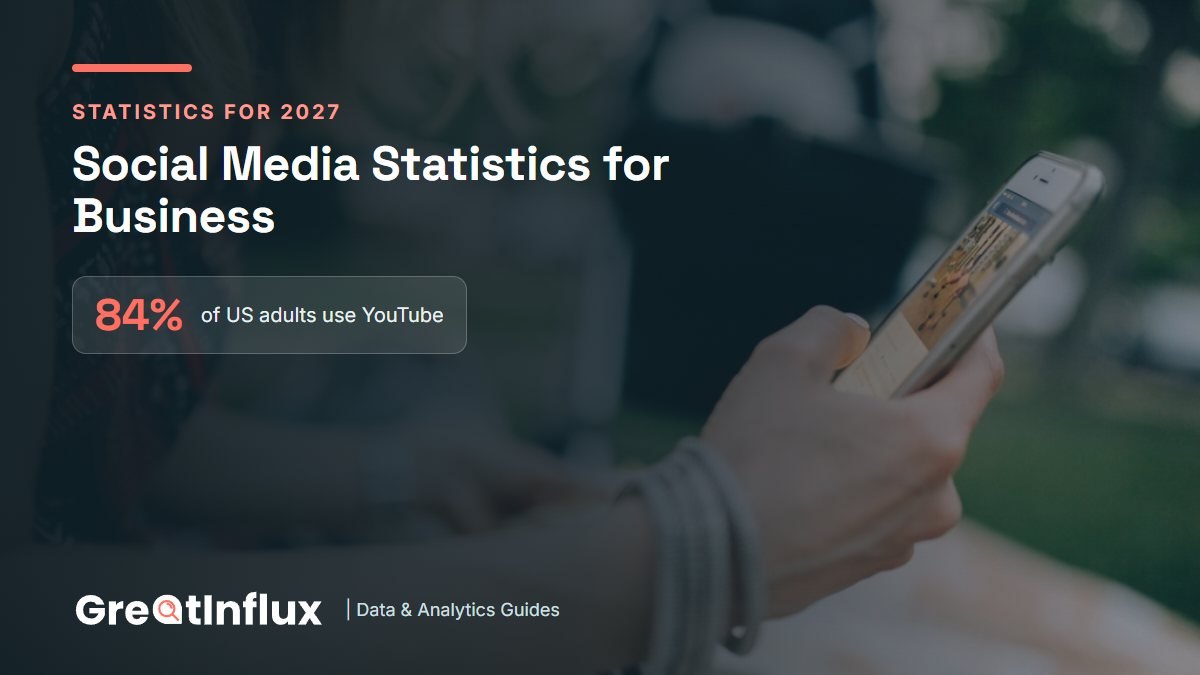
Table of contents
Business owners rarely agree on which social platform is worth the effort. One says the newest app has the young customers, another says the oldest one has the money, and someone else insists video is everything or that nobody uses a given site any more. These opinions mostly come from each person's own feed, which is a poor sample of anything.
Pew Research Center surveys thousands of U.S. adults, a national sample, about the platforms they use. The answer is less exciting but far more useful: most American adults still use YouTube and Facebook, half use Instagram, and TikTok, WhatsApp and Reddit each reach a substantial minority. On this page we combine Pew's figures with IAB's advertising revenue data and the FTC's disclosure rules, so you can decide where your limited time is best spent.
Social media statistics at a glance
| Statistic | Figure | Source |
|---|---|---|
| U.S. adults who use YouTube | 84% | Pew Research Center (2025) |
| U.S. adults who use Facebook | 71% | Pew Research Center (2025) |
| U.S. adults who use Instagram | 50% | Pew Research Center (2025) |
| U.S. adults who use TikTok | 37% | Pew Research Center (2025) |
| U.S. adults who use WhatsApp | 32% | Pew Research Center (2025) |
| U.S. adults who use Reddit | 26% | Pew Research Center (2025) |
| Adults aged 18 to 29 who use Instagram | About 8 in 10 | Pew Research Center (2025) |
| 18- to 29-year-olds on TikTok at least daily | Roughly half | Pew Research Center (2025) |
| U.S. social media ad revenue (2024) | $88.8 billion, up 36.7% | IAB |
Which platforms do Americans actually use?
YouTube and Facebook are used by the most Americans, by a wide margin. In Pew Research Center's 2025 survey, 84% of U.S. adults said they use YouTube and 71% said they use Facebook, while Instagram reaches half, TikTok 37%, WhatsApp 32% and Reddit 26%. Pew's latest fact sheet still lists YouTube and Facebook at the top.
The survey behind Pew's 2025 report on Americans' social media use covered 5,022 U.S. adults. The wording is plain: "The vast majority of U.S. adults (84%) say they ever use YouTube", "Most Americans (71%) also report using Facebook", and Instagram now reaches half of them. In its latest social media fact sheet, Pew says that no other platform in the U.S. is used by more people than YouTube and Facebook.
Two points deserve your attention. First, the older platforms aren't dying, and if you want to reach adults of every age, Facebook and YouTube are still the broadest choices. Second, "use" here means ever using the platform, not using it daily or paying attention to business content there, so reach is where you start and not what you end up with.
How does age change the picture?
Age changes the picture sharply, because younger adults are far more likely to use Instagram and TikTok. According to Pew, about eight in ten adults between 18 and 29 are on Instagram, and roughly half of that age group visit TikTok at least once a day. If your customers are young adults, these two matter far more to you than the overall averages suggest.
Most platform debates really get settled by age. A dental practice aimed at families, a trade business serving homeowners and a fashion brand aimed at students are each chasing a different audience, so they shouldn't copy one another's social plans. Begin with who your customers are, and then look at which platforms that group uses.
How much do businesses spend on social ads?
Businesses spend a lot on social ads, and the category is growing faster than any other large digital one. IAB reports that revenue from social media advertising in the U.S. hit $88.8 billion in 2024, up 36.7%, which makes up 34.3% of internet ad revenue overall.
According to IAB's full-year 2024 report, social is growing more than twice as quickly as search. More businesses are therefore competing for the same feeds, so prices tend to rise and generic ads blend into the noise. If you'd like to see how social stacks up against search, display and video, our digital advertising statistics lay it out.
What are the disclosure rules?
Anyone who is paid, gifted something or otherwise tied to a brand has to say so clearly. The FTC's guidance for influencers covers every kind of tie with a brand: financial, employment, personal or family. The wording should be simple and easy to understand, and it should sit where viewers can't miss it, for example "ad" or "sponsored".
The FTC's Disclosures 101 for social media influencers boils it down to three short rules: "Disclose when you have any financial, employment, personal, or family relationship with a brand", "Place it so it's hard to miss" and "Use simple and clear language." In business terms, that covers sending free products to creators, paying for posts or asking your staff to promote you.
A 2024 fake review rule from the FTC also bans buying fake social media indicators, for example bot followers or fake views. Paying for followers won't help your engagement, and in the U.S. it now carries legal risk too.
Choosing platforms for your business
| Platform | Reach among U.S. adults | Often suits | Content that tends to work |
|---|---|---|---|
| YouTube | 84% | Explaining services, how-to, reviews of products | Short explainers, answers to common questions, project walk-throughs |
| 71% | Local businesses, community, events, older audiences | Updates, offers, events, customer stories, reviews | |
| 50% (about 8 in 10 aged 18-29) | Visual products, food, beauty, home, younger audiences | Photos and short videos of real work and products | |
| TikTok | 37% | Younger audiences, personality-led brands | Short, informal videos; behind the scenes |
| 32% | Customer messaging and updates | Quick replies, appointment reminders where customers opt in | |
| 26% | Niche communities, research-heavy purchases | Genuine participation, not ads disguised as posts |
Treat the table as a starting point, because your own analytics and what customers tell you about where they spend time will teach you more. Our post on Reddit alternatives explains how community platforms differ, which is worth a read if Reddit tempts you.
Organic and paid social do different jobs
Organic social means the posts you publish on your own profile, and it builds familiarity and trust with people who already know you, such as customers, neighbours and past clients. Usually only a fraction of your followers will see a given post. Paid social gets you in front of people who haven't heard of you, or reminds recent website visitors that you exist, and you decide the audience and the budget.
Most small businesses need some of each. Organic posts give your profile life and credibility, so when an ad or a search result sends someone to check you out, they find a business that is clearly active. Even a small paid campaign can get your message to the people you want at a useful moment. The common mistake is relying on organic posting alone to bring in steady new customers, or paying for ads that lead to a profile gone quiet for a whole year.
Five content ideas for local businesses
These post ideas suit most local businesses and need only a phone, so they're a good place to begin if you're unsure what to share:
- Before and after. Show a finished kitchen, garden, car or smile, using real results and getting the customer's permission first.
- Answer a common question. A 30-second video answering something customers ask every week.
- Meet the team. Post a photo of one person with two lines about them, because people buy from people.
- Behind the scenes. Show things like new stock being unpacked, a busy day being prepared for or a van being loaded.
- Share a genuine review. Post a screenshot of a real review along with a thank-you, and never one that's been invented or edited.
How often should a business post?
There's no official number, and any figure you're quoted is a guess about your business. A rhythm you can keep up for a year beats a big plan that stalls after three weeks. Most small businesses can sustain a few good posts weekly across one or two platforms. Then trust your results: if posts answering questions get more engagement and website visits than offers, do more of those.
Steady beats frequent because people often look at your profile before they get in touch, and they want to see that someone's home. If your newest post is months old, visitors start to wonder, and a recent one would have put that to rest.
A practical social plan for a small business
- Choose one or two platforms. Go for the platforms your customers use most, even if they aren't the ones you enjoy yourself.
- Complete the profile properly. Fill in your name, contact details, hours, website link and a clear description, and make them all match your Google Business Profile.
- Post real work. For most local businesses, short videos and photos of real jobs, products and people do better than generic stock images.
- Answer messages and comments quickly. Customers will use social to reach you whether you plan for it or not, so treat it as a customer service channel.
- Disclose every paid or gifted partnership. Follow the FTC's rules.
- Test paid social with a fixed budget. Your safest first test is usually retargeting people who recently visited your website.
- Measure enquiries, not likes. Tag your links with UTM parameters and compare key events by source in GA4.
If you want support, you can look at our social media management service and social media advertising service, which deal with both organic and paid social.
How to measure social media properly
Followers and likes are easy to count, but you can't pay staff with them. What counts is whether social activity turns into visits, enquiries and sales. To see that, tag every link you share with UTM parameters so GA4 can tell you which platform and post sent each visit, and once a month compare sessions, engaged sessions and key events by social source.
Social will usually show up partly as an assist. A person might watch your video on Facebook, look you up by name a week later and then book through Google. Keeping an eye on brand searches in Search Console next to your social activity helps you spot that effect. A business analytics dashboard pulls these numbers together.
Figures you'll see elsewhere that we left out
Many social media statistics pages quote global user totals, average daily time spent and engagement benchmarks from social media tools. We didn't, because global totals differ widely from one source to the next and vendors' benchmarks reflect only their own customers. We also skipped Pew figures for platforms such as Snapchat, X, Pinterest and LinkedIn, since we couldn't verify them from the text of Pew's 2025 report. Each figure in the table is taken directly from Pew, IAB or the FTC.
Sources and method
Sources: Pew Research Center (its 2025 report on Americans' social media use and its social media fact sheet), IAB's report on internet advertising revenue for the full year 2024, and the U.S. Federal Trade Commission. We checked every figure against the source pages.
Frequently asked questions
Which social media platforms do most Americans use?
Pew Research Center's 2025 survey found 84% of U.S. adults use YouTube and 71% use Facebook. Half use Instagram, 37% TikTok, 32% WhatsApp and 26% Reddit.
How many young adults use Instagram and TikTok?
Pew reports that about eight in ten adults aged 18 to 29 use Instagram, and roughly half of 18- to 29-year-olds say they go on TikTok at least once a day.
How much do businesses spend on social media ads?
IAB reports that U.S. social media advertising revenue reached $88.8 billion in 2024, up 36.7%, the fastest growth among large digital ad categories.
Do influencers have to disclose sponsored posts?
Yes. The FTC says influencers should disclose any financial, employment, personal or family relationship with a brand, in simple and clear language placed where it is hard to miss, such as "ad" or "sponsored".
Which social platform should a small business start with?
The one your customers already use most. For many local businesses that means Facebook and Instagram, with YouTube for explainer videos. Business-to-business firms often add LinkedIn. Start with one or two and do them well.
How do I measure social media results?
Tag the links you share with UTM parameters, then compare sessions, engaged sessions and key events from each social source in GA4. Track enquiries and sales, not just likes and followers.
Why are some platforms missing from the statistics table?
We only included platform figures Pew states clearly in its 2025 report text. Figures for other platforms such as Snapchat, X, Pinterest and LinkedIn were not stated there in a form we could verify, so we left them out.